Margaret McIver transformed a modest yard in Glasgow's East End into one of Britain's most famous markets. Her journey from a policeman's daughter to the "Barras Queen" remains one of the city's most remarkable business stories.
From Fruit Barrow to Market Pioneer
Margaret Russell was born on 9 May 1880 in Galston, Ayrshire, to Thomas Russell, a policeman, and Margaret Sclanders, who worked as a French polisher. McIver entered the world of commerce early: at age 12, she was minding a fruit barrow in Parkhead. By her late teens, she had opened a fruit shop in Bridgeton.
It was at the fruit markets that she met James McIver. The couple married and built a business hiring horses and carts to local hawkers. This enterprise provided the foundation for what would become The Barras.
The Birth of The Barras
In the early 1920s, with street traders facing pressure from Glasgow Corporation, the McIvers offered a solution. They opened their yard on Marshall Lane in the Calton district to hawkers who needed legitimate trading space. The operation grew rapidly: at its height, McIver had hired out over 300 barrows to local traders. The name "Barras" derives from the Glaswegian dialect word for barrow, the handcarts that defined the market's early years.
Traders paid threepence per day or eightpence per week to rent a barrow. Many of these stalls were operated by women, making McIver an unusual female employer in an era when business ownership remained predominantly male.
Building the Market Infrastructure
McIver demonstrated sharp business instincts as the market expanded. In 1926, she made the decision to roof the market, primarily to protect clothing hawkers from Glasgow's notoriously unpredictable weather. By 1928, the site was fully enclosed, transforming the open-air barrow yard into a permanent indoor market.
The market's growth continued throughout the 1930s. The venture proved so successful that McIver acquired additional land, eventually developing the site on Moncur Street that would become the market's permanent home.
The Barrowland Ballroom
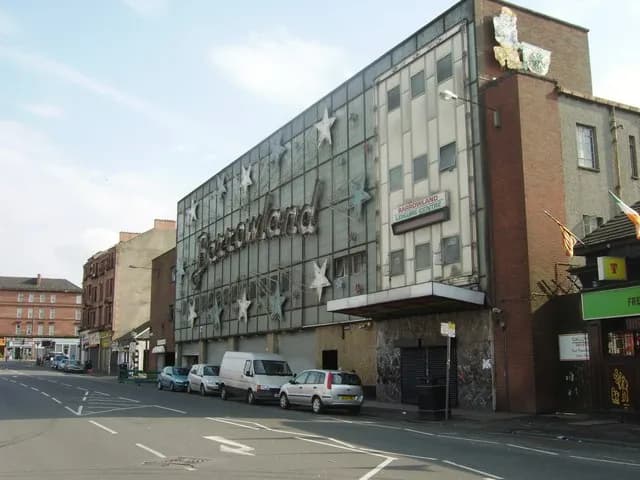
McIver's vision extended beyond commerce into community. In 1934, after finding it impossible to hire a suitable hall for the hawkers' annual Christmas party, she decided to build her own. The Barrowland Ballroom opened on Christmas Eve 1934, designed by architect James Miller with a capacity of 1,900.
The original ballroom was destroyed by fire in 1958; the building that stands today was rebuilt and reopened on Christmas Eve 1960. It remains one of Glasgow's most celebrated music venues, its neon sign a landmark in the East End.
Personal Tragedy and Business Resilience
McIver's business achievements unfolded against a backdrop of personal loss. James McIver died of malaria contracted during the First World War, leaving Margaret widowed at 49 with nine children to raise. Rather than retreat from business, she expanded her operations. By the time of her death in 1958, she had become a multi-millionaire; an extraordinary accomplishment for a working-class woman in mid-20th century Scotland.
Legacy and Remembrance
Today The Barras comprises over 1,000 stalls across 10 markets, remaining a fixture of Glasgow's commercial landscape. McIver's contributions are commemorated by a plaque at the Barrowland Ballroom and a stone carving at the gates of Glasgow Green.
The market has faced challenges in recent decades. In 2016, Glasgow City Council considered redevelopment proposals for an arts, events, and music quarter in the area. Yet the fundamental character of The Barras, rooted in McIver's original vision of accessible trading space for working-class entrepreneurs, persists.
From 300 borrowed barrows to a multi-million-pound enterprise, McIver's story illustrates how Glasgow's East End has long served as a cradle of commercial innovation and working-class entrepreneurship.