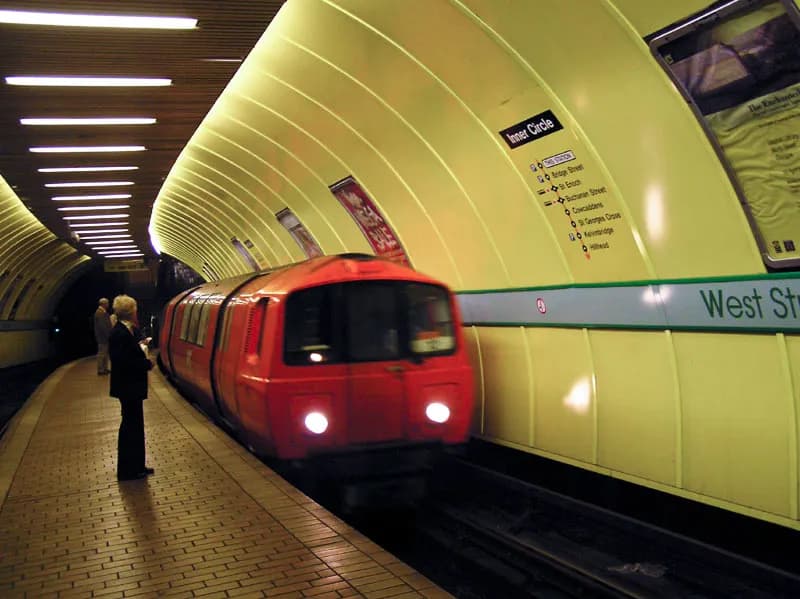
Glasgow's subway has been running beneath the city's streets since 1896, making it the third-oldest underground metro system in the world. The 10.5-kilometre circular loop has remained unchanged for 129 years, yet continues to evolve with new rolling stock, modern signalling, and plans for driverless operation.
From Cable to Electric
The Glasgow District Subway received Royal assent on 4 August 1890, and construction began the following year. When it opened on 14 December 1896, it became the first mass transit system in the world to be known as a "subway". The original trains were cable-hauled using a clutch-and-cable system, with the last cable car service running on 30 November 1935. Electrification at 600 V DC cost £120,000, equivalent to approximately £7.4 million today. The Glasgow Corporation acquired the system in 1923 for £385,000.
The Orange That Isn't Orange
The system's popular nickname, "The Clockwork Orange," reflects both its circular route and the bright colour of its carriages. The name is sometimes attributed to Sir Peter Parker, chairman of British Rail in the late 1970s, though its exact origin remains disputed. Officially, the livery is "Strathclyde PTE red," as "Orange" carries sectarian connotations in Glasgow. Most locals simply call it "the Subway" or "the Underground." Before modernisation, it was known as the "Shoogly Train" — "shoogly" meaning shaky in Scots — referring to the distinctive rocking motion of the carriages.
Unique Engineering
The Glasgow Subway employs a unique 4 ft (1,219 mm) narrow gauge, one of the few railways worldwide to use this specification. Its tunnels measure just 11 ft (3.4 m) in diameter, smaller than even London Underground's deepest lines. These tight constraints have forced every generation of trains to be custom-built for the system. The 15 stations are arranged in a double-track circular loop with two services: the Outer Circle running clockwise and the Inner Circle anticlockwise. The entire route lies underground except for the Broomloan Road maintenance depot between Govan and Ibrox stations.
The 1977–1980 Transformation
The subway closed on 21 May 1977 for comprehensive modernisation, eight days earlier than planned after cracks appeared in the Govan Cross station roof. Queen Elizabeth II and Prince Philip officially inaugurated the modernised system on 1 November 1979, travelling from Buchanan Street to St Enoch. Passengers returned on 16 April 1980 to find rebuilt stations, new ticketing systems, automatic train operation, and 33 new carriages built by Metro-Cammell with exterior design input from Glasgow School of Art. The Merkland Street station closed, replaced by a new Partick station providing interchange with the North Clyde Line.
Third-Generation Trains
The most recent transformation began with a £246 million Scottish Government pledge in 2012. A £200 million contract awarded to Stadler and Ansaldo STS in 2016 delivered 17 new four-car trainsets, custom-made at Stadler's Altenrhein facility in Switzerland to fit the subway's unique tunnel dimensions. The first Stadler train arrived in May 2019, with passenger service beginning on 11 December 2023. The second-generation trains were fully withdrawn by 28 June 2024. Unlike their predecessors, the new trains feature open gangways between carriages. Platform Screen Doors are being installed station by station, with half-height versions at Govan preserving the open feel of the platforms. Once testing is complete, the system will support Unattended Train Operation.
Sustainable Innovation
The subway has won a Scottish Transport Award for sustainability through its innovative use of tunnel groundwater and air source heat pumps to warm stations. A £16 million tunnel improvement programme completed between 2015 and 2020 included grouting works using 175,000 bags of material, drainage renewal, and structural strengthening.
Current Operations
Strathclyde Partnership for Transport (SPT) operates the subway, carrying approximately 13 million passengers annually. Services run from 06:30 to 23:40 Monday through Saturday, with slightly reduced Sunday hours. Trains arrive every 4 minutes at peak times and every 6–8 minutes off-peak. The full circuit takes 24 minutes. A flat fare structure applies, with over 350,000 Subway Smartcards issued as of January 2025. Contactless payment arrived at all 15 stations in March 2026. British Transport Police have provided policing since 2007, and Park and Ride facilities operate at Bridge Street, Kelvinbridge, and Shields Road.
Cultural Threads
The subway has woven itself into Glasgow's cultural fabric. "The Underground Song," a satirical number by Glaswegian writer Cliff Hanley, gained popularity through comedians Rikki Fulton and Jack Milroy's "Francie and Josie" act. The "Subcrawl" remains a beloved local tradition, challenging participants to visit all 15 stations and have a drink at the nearest pub to each. The iShoogle app, launched in 2012, allows users to check in at stations via social media. The Riverside Museum houses a full-scale replica of a pre-modernisation subway station, complete with preserved carriages numbered 41T and 39T, offering visitors a glimpse of the system's earlier era.
Looking Forward
Transport Scotland's Strategic Transport Projects Review 2, published in 2022, retains the subway within proposed "Clyde Metro" developments, including potential for a new West Street station. Sunday service hours are set to extend to 06:30–23:30 following approved plans. The system that began as a Victorian cable railway continues adapting to twenty-first-century demands while remaining, in essence, the same 6½-mile circle beneath Glasgow that opened 129 years ago.