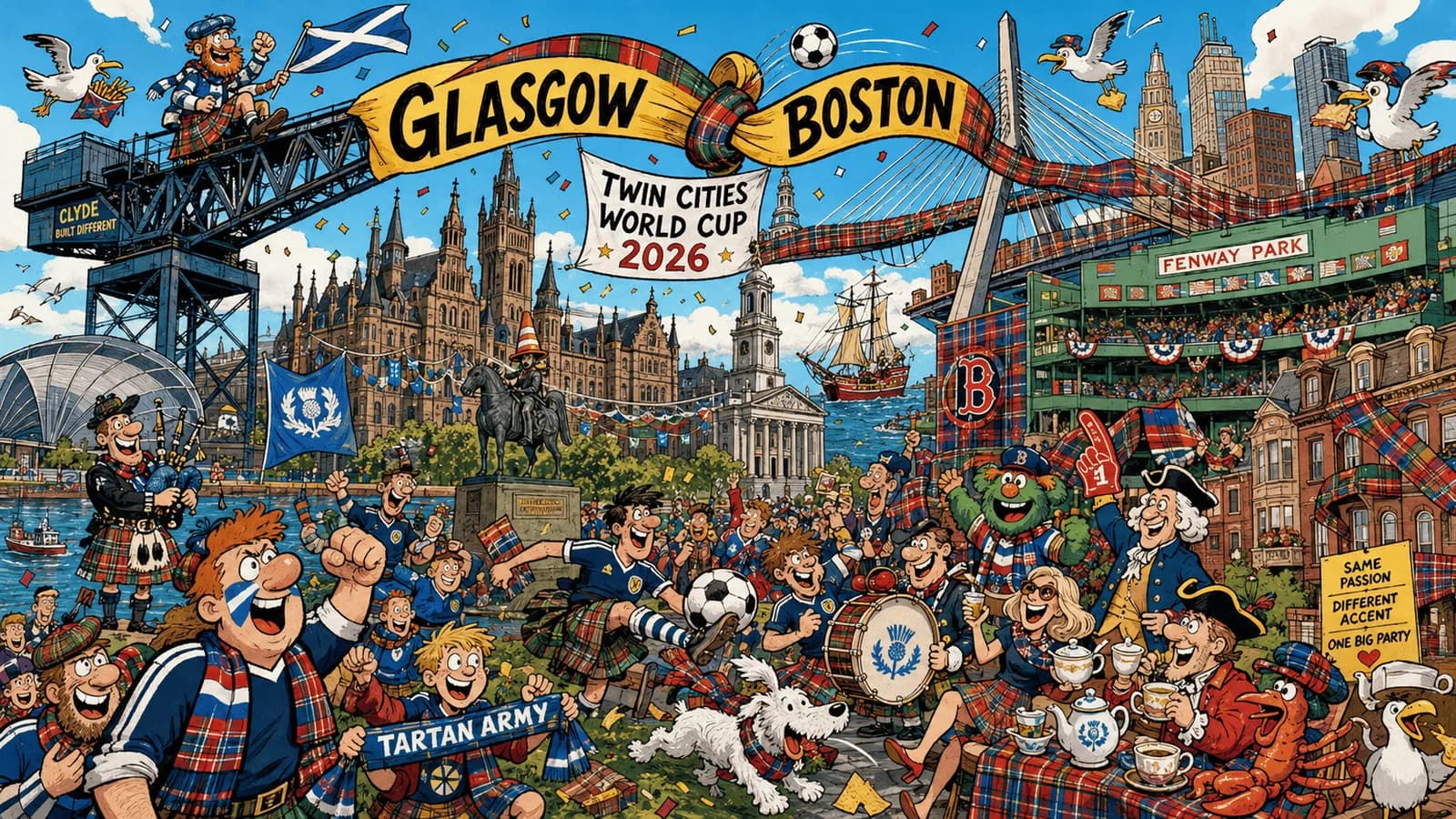
Glasgow and Boston are preparing to make their new friendship official after the Tartan Army’s unforgettable World Cup takeover of Massachusetts turned a football trip into something much bigger.
What began as a base camp for Scotland supporters during the FIFA World Cup 2026 has quickly become a story of sport, culture, history and civic diplomacy. According to reporting by The Herald, a letter of intent has now been signed to formally twin Glasgow with Boston, with a full agreement expected to follow next April during Tartan Week.
The symbolic signing took place at The Haven, Boston’s dedicated Scottish bar, which has become an unofficial headquarters for Scotland fans throughout the tournament. For days, the venue has been less a bar and more a temporary embassy: tartan at the doors, songs in the streets, pints moving faster than staff could pour them, and a city discovering just how loudly Scotland can travel.
Boston Mayor Michelle Wu, wearing a Scotland top for the announcement, thanked the visiting supporters for “making our city come alive”, The Herald reported. It was the kind of image that captures why this story has travelled so widely: a mayor in dark blue, a room full of Scots thousands of miles from home, and two cities suddenly recognising something familiar in each other.
This is not just a nice civic gesture. It is soft power with a drumbeat. Scotland’s fans have not simply arrived in Boston; they have changed the mood of the city.
Tens of thousands of supporters have used Boston as their base while Scotland play their group matches at nearby Foxborough. After Scotland’s 1-0 win over Haiti, secured by John McGinn, the celebration spilled far beyond the football ground. Streets, bars, fan zones and even Fenway Park became part of the Scottish story.
Some Boston venues reportedly struggled to keep up with demand as Scotland fans filled the city’s bars. That detail has become part of the folklore already, but the more important point is what followed it. Locals did not respond with irritation. They responded with affection.
The Tartan Army have been praised for their warmth, humour, generosity and good behaviour. There have been viral clips, bagpipes, spontaneous chants, fans mingling with Haitians and Americans, and stories of Scots cleaning up after themselves after long days and longer nights of celebrating. The result is a rare kind of sporting reputation: loud enough to be impossible to ignore, but good-natured enough to be welcomed back.
That is why the Glasgow-Boston link feels more natural than opportunistic.
Both cities know what it means to be proud, funny, stubborn, creative and deeply attached to their own identity. Glasgow has the Clyde, shipyards, music, football, humour and hard-earned cultural confidence. Boston has the Charles, revolutionary history, neighbourhood pride, universities, sport and a fierce civic personality of its own. Neither city is shy. Neither city does bland particularly well.
The historical connections also run deeper than this one World Cup summer.
One of the links highlighted around the announcement is Henry Knox, the American Revolutionary War figure whose artillery mission helped force the British evacuation of Boston in 1776. Knox’s famous winter movement of cannon from Fort Ticonderoga to Dorchester Heights remains one of the great logistical feats of the American Revolution. It helped change the fate of Boston and gave the city one of its defining historical moments.
Then there is the football connection, almost too perfect for the occasion. On 18 June 1928, Fenway Park hosted Glasgow Rangers against the Boston Wonder Workers. The match ended 2-2 in front of around 10,000 spectators, a reminder that Scottish football has been echoing around Boston for nearly a century.
That detail matters because it shows this relationship did not appear out of nowhere. The World Cup has simply brought old threads back into view.
Boston has long been shaped by immigrant communities, including Scots and Irish, and its football history was influenced by workers and families who brought the game with them. Glasgow, meanwhile, has always been outward-looking: a port city, a trading city, a city of migration, reinvention and international connections.
The proposed twinning would give that shared character a formal structure. Glasgow already has twin-city relationships around the world, including with Nuremberg, Dalian, Havana, Turin, Lahore, Marseille, Bethlehem and Mykolaiv. Boston also maintains a sister cities programme designed to build cultural, educational, economic and civic links across borders.
If the agreement is completed next April, Boston would become Glasgow’s newest twin city and one of its most culturally resonant.
For Glasgow, the moment carries another benefit. It shows the city at its best on a global stage without needing to host the tournament itself. The travelling support has done the ambassadorial work in real time. Every song in a Boston street, every flag at Fenway, every friendly exchange with local fans has helped sell a version of Scotland that is confident, welcoming and impossible to forget.
For Boston, the relationship offers more than a week of good headlines. It gives the city a permanent civic link to one of Europe’s great cultural capitals: a city of music, sport, universities, comedy, design, business, food, politics and working-class wit. Glasgow is not a city that politely fades into the background. Neither is Boston. That may be exactly why this works.
The sporting timing could hardly be better. Scotland’s World Cup return, after a 28-year absence, has already produced a historic win and a wave of emotion among supporters who waited decades for nights like these. For many fans, being in Boston has felt like being part of something once-in-a-generation: not just watching Scotland at a World Cup, but watching Scotland be embraced by another city.
That is the real story here. The twinning agreement is the formal chapter, but the bond was written first in the streets.
It was written in bagpipes at Logan Airport, in blue shirts at Fenway, in packed bars, in shared chants, in American curiosity about Irn-Bru and haggis, in Haitian and Scottish fans dancing together, and in a city that seemed to realise, almost instantly, that the Tartan Army were not just visitors passing through.
They had brought Glasgow with them.
Now Boston and Glasgow look set to turn that feeling into a lasting friendship. A World Cup host city and a Scottish football city. The Charles and the Clyde. Two places with grit, noise, humour and history in their bones.
For once, the phrase “special relationship” does not feel like diplomatic padding.
It feels like something that started with a song, a Scotland top and a few thousand fans who made themselves at home.