In the space of a single century, Glasgow transformed from a modest provincial town into one of Europe's greatest commercial cities. The shift was driven first by American tobacco and later by the industries that rose along the River Clyde, a transition that reshaped the city's streets, skyline, and global standing.
The Tobacco Boom, 1710–1775
Following the Act of Union in 1707, Glasgow's merchants gained unrestricted access to Atlantic trade routes. The city became the dominant British port for American tobacco; by the 1750s, Glasgow handled more of the American tobacco crop than all other British ports combined. This dominance lasted for roughly fifty years from 1710 and created a class of extraordinarily wealthy merchants known as the Tobacco Lords.
The Men Who Owned the Trade
The most prominent figures included Andrew Buchanan of Drumpellier, John Glassford, Andrew Cochrane of Brighouse, and William Cunninghame. John Glassford entered the tobacco trade in 1750 and built a fleet of vessels and a network of stores across New England. He was reportedly trading for more than half a million pounds sterling annually before the outbreak of the American War of Independence. Their wealth was immense; William Cunninghame spent £10,000 on his neo-classical mansion, completed in 1780, a sum equivalent to roughly £1.55 million today.
Mansions, Streets, and a New City Centre
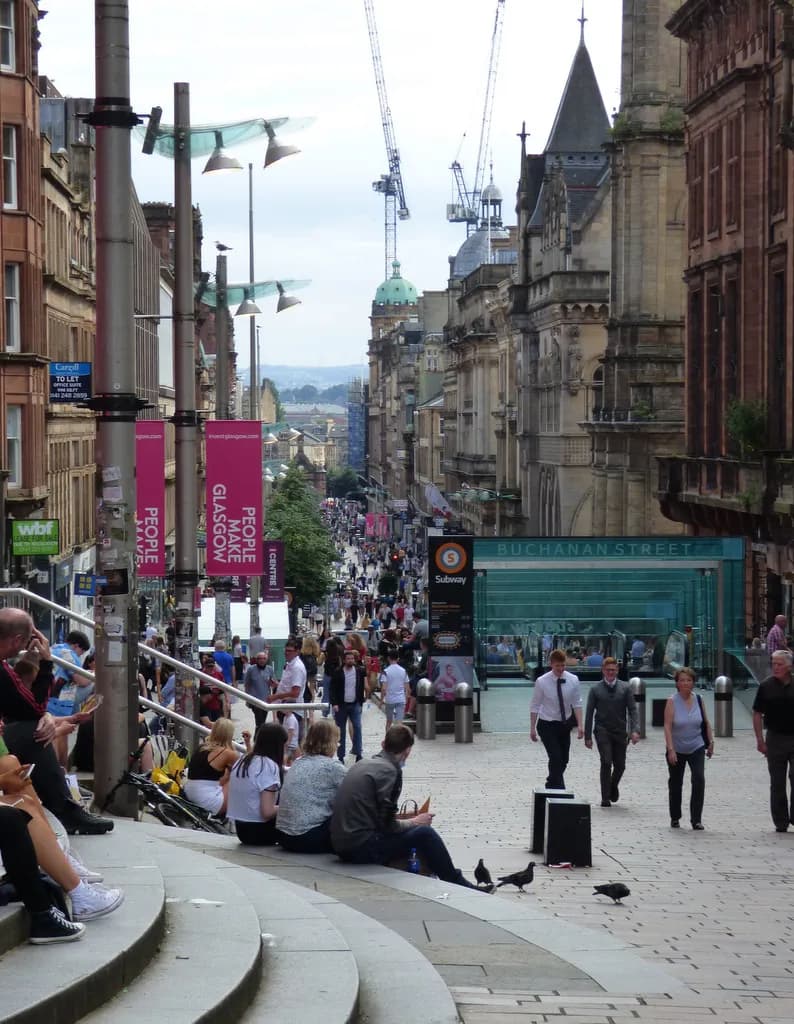
The Tobacco Lords built their homes on the western edge of the eighteenth-century city, creating what is now Glasgow's Merchant City. Streets were named after the merchants themselves: Buchanan Street and Glassford Street survive today. Virginia Street took its name from the Virginia Mansion of Alexander Speirs. Cunninghame's mansion, on Royal Exchange Square, now houses the Glasgow Gallery of Modern Art. Their collective influence was also displayed in St Andrew's Parish Church in St Andrew's Square, built between 1739 and 1756 as a conspicuous statement of their power.
The American Revolution and the Collapse
The American War of Independence, from 1775 to 1783, abruptly severed the tobacco supply chain. Few of the substantial debts owed by American colonists to Glasgow merchants were ever repaid. Some traders were ruined; others survived by pivoting rapidly to new markets.
Reinvention: From Leaf to Loom
Rather than retreat, the surviving merchants redirected their capital towards other parts of the transatlantic trade, notably cotton from the British West Indies. Glasgow's textile sector expanded swiftly; by 1770 the city was Britain's largest linen manufacturer, and by the 1780s its mills were producing fine cotton muslins for export across Europe. This laid the foundation for the city's nineteenth-century industrial economy.
The River That Would Build the World
A parallel transformation was taking place on the water. De-silting and dredging of the River Clyde in the 1770s allowed larger vessels to sail further upstream, a technical improvement that proved essential to later shipbuilding. Shipbuilding on the Clyde had begun with small yards; the Scott family opened a yard at Greenock in 1712. After 1860, Clydeside yards shifted from wooden sailing vessels to iron and then steel steamships, and the term "Clydebuilt" became an international mark of quality. Lanarkshire's abundant coal and iron reserves provided the raw materials that fed this expansion.
Population and Urban Growth
The economic surge reshaped Glasgow physically. James Barrie introduced a new grid system above Ingram Street in 1772, and the city centre pushed westward. The population rose from approximately 32,000 in 1750 to roughly 200,000 by 1850. Public buildings erected during this era, including the Trades Hall on Glassford Street and later additions such as the City Chambers on George Square, reflected the confidence of a city that had already secured its place as an industrial superpower.